
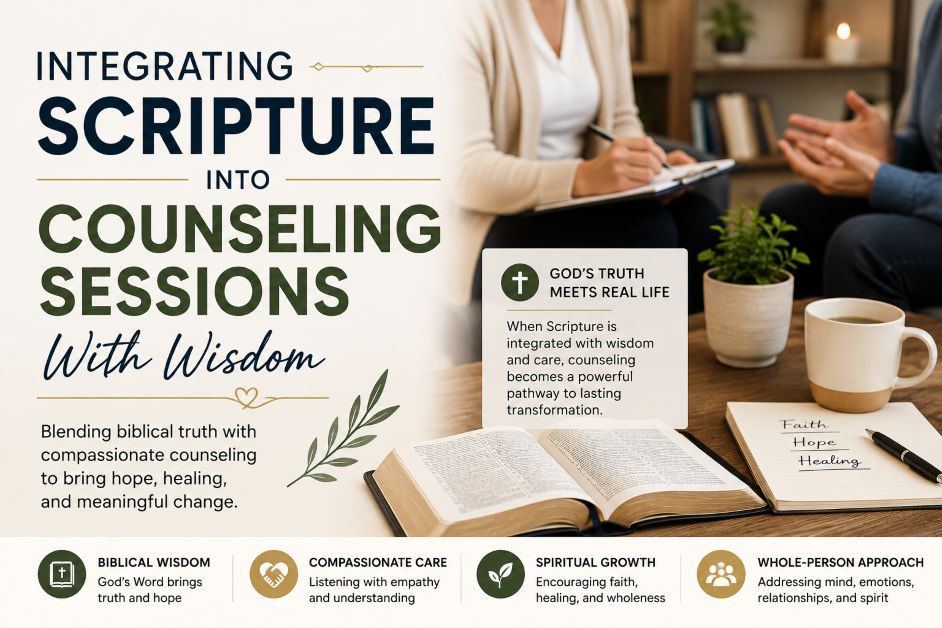
Integrating Scripture Into Counseling Sessions With Wisdom requires more than choosing a Bible verse and placing it into a conversation. Effective Christian counseling considers the whole person—their emotions, relationships, spiritual beliefs, personal history, and current circumstances—while treating Scripture with care and respect.
For many Christians, biblical wisdom in counseling can provide hope, perspective, and spiritual direction during difficult seasons. Scripture can help people reflect on questions of identity, suffering, forgiveness, fear, purpose, and faith. At the same time, responsible faith-based counseling recognizes the importance of client autonomy, informed consent, appropriate clinical judgment, and professional boundaries.
The goal is not to turn a counseling session into a sermon. Instead, integrating Scripture into counseling can create space for thoughtful reflection, spiritual growth, emotional healing, and practical change.
What Does Integrating Scripture Into Counseling Sessions Mean?
Scripture and counseling can work together when biblical truth is introduced thoughtfully and applied in a way that respects the client’s needs and beliefs.
There is an important difference between simply quoting a verse and practicing responsible Scripture-based counseling.
A counselor may use Scripture to:
- Explore a client’s understanding of God.
- Encourage hope during suffering.
- Examine beliefs about identity and worth.
- Reflect on forgiveness and reconciliation.
- Consider wisdom when making decisions.
- Support spiritual growth.
- Encourage prayer when appropriate.
- Help clients connect faith with everyday choices.
The passage should serve the counseling conversation rather than replace it.
Responsible biblical counseling also recognizes that people may respond differently to the same passage. A verse that provides comfort to one person may raise difficult questions for another. This is why biblical interpretation, context, compassion, and listening matter.
Why Biblical Wisdom Can Matter in Christian Counseling
The Bible addresses many experiences that arise in counseling, including grief, fear, conflict, shame, uncertainty, suffering, hope, and relationships.
Biblical guidance can help clients consider their circumstances through the lens of Christian faith while continuing to work through practical emotional and relational concerns.
Scripture Can Provide Meaning During Difficult Seasons
People often ask questions about meaning when they experience loss, disappointment, or prolonged difficulty. Biblical narratives can provide language for lament, perseverance, hope, and trust.
This does not mean every painful experience needs an immediate spiritual explanation. Good counseling allows room for honest emotions and unanswered questions.
Scripture Can Support Hope and Perseverance
Christian hope can become an important source of encouragement when circumstances feel uncertain.
A counselor can invite reflection on biblical promises while also helping the client identify practical steps for coping, communicating, setting boundaries, or making decisions.
Scripture Can Shape Values and Decisions
Spiritual wisdom can help clients examine the values guiding their choices. Scripture may provide principles related to honesty, humility, compassion, responsibility, forgiveness, patience, and love.
The counselor’s role is to help the client thoughtfully consider those principles rather than dictate every decision.
Start With the Client, Not the Bible Verse
One of the most important principles of integrating Scripture into counseling is to begin by listening.
Before selecting a passage, counselors should understand the client’s:
- Present concern
- Emotional state
- Counseling goals
- Spiritual beliefs
- Biblical background
- Personal history
- Cultural context
- Readiness for spiritual discussion
This approach strengthens the therapeutic relationship because the client remains an active participant in the process.
Ask Permission Before Introducing Scripture
Informed consent is especially important when integrating faith into counseling.
A counselor might say, “Would you be comfortable exploring a biblical perspective on this?”
This simple question respects client autonomy and gives the person an opportunity to participate willingly.
Respect Clients Who Are Uncertain About Faith
Some Christians experience doubt, disappointment with religious institutions, or difficult questions about God. Others may have experienced spiritual trauma or religious trauma.
These experiences should be approached with patience rather than judgment.
Recognize Spiritual Readiness
A client may appreciate prayer during one session but need emotional processing during another. Wise counseling pays attention to timing.
How to Choose a Bible Passage for a Counseling Session
Choosing Scripture requires more than finding a verse containing a keyword related to the client’s problem.
A practical approach includes five steps:
- Identify the client’s concern.
- Clarify the counseling goal.
- Identify an appropriate biblical theme.
- Study the passage in context.
- Invite the client to reflect on its meaning.
Match Scripture to the Counseling Concern
Different biblical themes may relate naturally to different concerns.
For anxiety, counselors may explore themes of peace, God’s presence, wisdom, and trust.
For grief, biblical passages involving lament, comfort, and hope may provide language for honest sorrow.
For shame, themes of grace, identity, forgiveness, and restoration may help clients examine destructive beliefs.
For relationship conflict, Scripture concerning humility, patience, communication, forgiveness, and love may support reflection.
For spiritual doubt, passages involving faith, questions, perseverance, and God’s faithfulness can provide room for honest exploration.
Consider the Context of the Passage
Scripture context matters.
Counselors should consider the surrounding verses, historical setting, literary genre, intended audience, and broader biblical teaching.
This protects against using isolated verses to make claims that the original passage does not support.
Avoid Using Scripture as a Quick Fix
A Bible verse cannot automatically resolve trauma, depression, grief, addiction, marital conflict, or other complex concerns.
Christian mental health support should take the person’s emotional and psychological needs seriously.
A Step-by-Step Framework for Integrating Scripture Into a Counseling Session
A practical faith integration framework can help counselors use Scripture responsibly.
Step 1 — Listen Before Offering Scripture
Begin with the client’s story. Listen for emotions, beliefs, patterns, concerns, and goals.
Step 2 — Identify the Client’s Spiritual Perspective
Ask how faith influences the situation. Do not assume the answer.
Step 3 — Ask Permission
Give the client a genuine choice about whether to explore Scripture.
Step 4 — Introduce the Passage
Briefly explain why the passage may relate to the conversation.
Step 5 — Read and Explore the Context
Allow time for the client to understand the passage rather than immediately applying it.
Step 6 — Ask Reflective Questions
Ask what stands out, what feels encouraging, and what feels difficult.
Step 7 — Connect Biblical Truth With the Client’s Situation
Help the client consider how the passage relates to their thoughts, emotions, relationships, and decisions.
Step 8 — Develop a Practical Response
Translate reflection into a realistic counseling goal.
Step 9 — Decide Whether Prayer Is Appropriate
Prayer should remain consistent with consent and the client’s preferences.
Step 10 — Follow Up
Revisit the discussion in a later session and ask what the client noticed or experienced.
How to Use Scripture Without Proof-Texting
Proof-texting occurs when a verse is removed from its context and used to support a predetermined idea.
This can create confusion and may unintentionally cause spiritual harm.
Read the Passage in Its Biblical Context
Look beyond a single sentence. Examine the surrounding passage and its larger message.
Consider Genre and Original Meaning
Poetry, wisdom literature, narrative, prophecy, letters, and other biblical genres communicate differently.
Understanding these differences supports responsible biblical interpretation.
Avoid Promising Instant Healing
Christian faith offers hope, but counselors should avoid implying that every emotional struggle disappears immediately after prayer or Scripture reading.
Let Scripture Invite Reflection
A healthy Scripture discussion opens a conversation rather than ending it.
Questions Counselors Can Ask After Reading Scripture
Reflective questions can help clients connect God’s Word in counseling with their lived experience.
Examples include:
- What stands out to you in this passage?
- What emotions does this passage bring up?
- How does this connect with what you are experiencing?
- Is anything in the passage difficult for you?
- What gives you hope?
- What questions does this passage raise?
- How might this truth influence your decision?
- What practical step could you take this week?
These questions encourage participation instead of turning Scripture into a one-sided instruction.
Integrating Scripture With Professional Counseling Wisdom
Christian therapy can incorporate spiritual beliefs while also recognizing appropriate professional methods.
Responsible counseling may include evidence-informed counseling, emotional assessment, psychological insight, relational work, spiritual care, and appropriate referral.
Scripture Is Not a Substitute for Mental Health Treatment
Some concerns require specialized professional care. Severe symptoms, safety concerns, trauma-related difficulties, substance use, or persistent mental-health problems should receive appropriate attention.
When Professional Referral Is Needed
A counselor should recognize the limits of their counselor competence and seek consultation, supervision, or referral when a client’s needs exceed their training.
When Collaboration With a Pastor May Help
With appropriate permission and boundaries, collaboration with a trusted pastor or spiritual leader may support a client’s spiritual needs.
Ethical Considerations When Using Scripture in Counseling
Ethics should remain central to Scripture integration in counseling.
Informed Consent
Clients should understand that spiritual practices or Scripture may be included and should have meaningful choices.
Client Autonomy
Clients retain the right to disagree, question, or decline spiritual interventions.
Avoiding Spiritual Pressure
Counseling should never use fear, shame, or spiritual authority to force a particular response.
Maintaining Professional Boundaries
The counselor should distinguish counseling from preaching, pastoral authority, or personal religious persuasion.
Protecting Confidentiality
Confidentiality remains essential in Christian counseling, just as it is in other professional counseling settings.
Recognizing Spiritual Abuse and Religious Trauma
Counselors should be careful when working with clients whose religious experiences have contributed to fear, shame, manipulation, or emotional harm.
Using Scripture for Common Counseling Concerns
| Counseling concern | Biblical theme | Counseling application |
|---|---|---|
| Anxiety | Peace and trust | Explore fearful thoughts and coping patterns |
| Grief | Lament and comfort | Allow space for honest sorrow |
| Shame | Grace and identity | Examine destructive self-beliefs |
| Betrayal | Forgiveness and boundaries | Separate forgiveness from unsafe reconciliation |
| Depression | Hope and God’s presence | Combine spiritual support with appropriate professional care |
| Anger | Wisdom and self-control | Explore triggers and responses |
| Relationship conflict | Love and humility | Develop healthier communication |
| Spiritual doubt | Faith and honest questions | Create space for exploration |
Scripture, Prayer, and Spiritual Reflection
Prayer in counseling can be meaningful when it reflects the client’s preferences and the counselor’s professional role.
Other practices may include:
- Guided Scripture reflection
- Journaling
- Prayer
- Scripture memorization
- Personal reflection
- Bible study
- Spiritual goal setting
These practices can connect counseling insights with everyday Christian living.
How Scripture Can Support Spiritual Transformation
Thoughtful spiritual transformation can involve changes in beliefs, relationships, habits, identity, and dependence on God.
Journey Through the Cross Spiritual Transformation
A Journey through the cross spiritual transformation can provide a framework for considering sacrifice, grace, redemption, and new life through Christ.
Christian Healing Through Suffering Testimony
A Christian healing through suffering testimony may encourage people who feel alone in difficult seasons. However, testimonies should never imply that another person’s healing experience is a required formula for everyone.
Resting in Grace Beyond Religious Striving
Resting in grace beyond religious striving can help people distinguish God’s grace from performance-based spirituality. This perspective may be particularly meaningful for clients who feel they must earn God’s acceptance.
Breaking Spiritual Strongholds Through Intimacy With God
Breaking spiritual strongholds through intimacy with God can involve prayer, Scripture, community, repentance, healthy habits, and growing dependence on God.
Christian Identity Healing From Emotional Abandonment
Christian identity healing from emotional abandonment can help clients examine painful beliefs about rejection, worth, belonging, and identity through a Christian framework.
What a Wise Scripture-Based Counseling Session Can Look Like
Consider a client experiencing anxiety about an uncertain future.
The counselor first listens and helps identify the thoughts and circumstances contributing to the anxiety.
The counselor then asks whether the client would like to explore a biblical perspective.
After receiving permission, the counselor introduces an appropriate passage and explains its context.
Rather than immediately telling the client what the passage means for them, the counselor asks:
“What stands out to you?”
The client identifies a theme of trust but also admits feeling unable to trust God consistently.
The counselor can then explore both the spiritual question and the emotional pattern. Together, they may identify anxious thought patterns, develop a practical coping strategy, and establish a reflection exercise for the week.
This approach combines biblical wisdom, emotional awareness, and practical counseling.
Common Mistakes to Avoid When Integrating Scripture
Giving a Verse Too Quickly
Listening should come before advice.
Treating Every Problem as a Spiritual Problem
Emotional, relational, psychological, physical, and spiritual factors can interact.
Ignoring Clinical Factors
Faith should not prevent appropriate professional assessment.
Using Scripture to Shame a Client
Biblical truth should never become a weapon of condemnation.
Assuming Every Christian Interprets a Passage the Same Way
Christian communities have different theological traditions and interpretations.
Confusing Forgiveness With Removing Healthy Boundaries
Forgiveness does not automatically require continued access to an unsafe person.
Turning Counseling Into a Sermon
The counseling relationship should remain centered on the client’s needs and goals.
How Counselors Can Grow in Biblical Wisdom
Effective biblical counseling techniques require ongoing development.
Counselors can strengthen their practice by:
- Studying Scripture carefully.
- Developing sound biblical discernment.
- Continuing professional education.
- Practicing self-reflection.
- Receiving counseling supervision.
- Seeking wise counsel.
- Cultivating prayer and spiritual maturity.
- Learning about trauma and mental health.
- Understanding the limits of their professional competence.
The counselor’s own spiritual formation matters because responsible care requires humility.
Frequently Asked Questions About Integrating Scripture Into Counseling
Can Scripture be used in professional counseling?
Yes, when appropriate to the counseling setting, client’s preferences, professional standards, and counselor competence. Scripture should be integrated responsibly rather than imposed.
Should a counselor ask permission before discussing Scripture?
Asking permission is a strong way to respect client autonomy and support informed participation.
How can counselors avoid proof-texting?
Study the passage in context, consider its genre and original meaning, and avoid forcing a verse to answer a question it does not address.
Can Christian counseling use evidence-based therapy?
Christian counseling can incorporate appropriate professional methods while also respecting a client’s Christian beliefs and spiritual goals.
What Bible passages are helpful in counseling?
The appropriate passage depends on the client’s concern, spiritual perspective, counseling goal, and the context of the biblical text.
Can prayer be part of a counseling session?
Prayer may be appropriate in some settings when the client is comfortable with it and the practice fits the counselor’s role, professional standards, and boundaries.
What if a client struggles with faith or has spiritual doubts?
Doubt can be explored respectfully. Counselors should create space for honest questions rather than treating doubt as a moral failure.
How can counselors integrate Scripture without becoming preachy?
Listen first, ask permission, explain the passage carefully, invite reflection, and connect biblical themes with the client’s own goals and experiences.
Conclusion: Integrating Scripture With Wisdom, Compassion, and Care
Integrating Scripture Into Counseling Sessions With Wisdom is ultimately about more than selecting the right Bible verse. It requires listening carefully, understanding Scripture in context, respecting client autonomy, obtaining informed consent, maintaining professional boundaries, and recognizing the emotional, psychological, relational, and spiritual dimensions of a person’s experience.
When used thoughtfully, Scripture and counseling can create meaningful opportunities for reflection, hope, spiritual growth, and practical change. The counselor does not need to choose between compassion and truth, faith and professional responsibility, or spiritual care and emotional support.
Instead, wise Christian counseling can bring these elements together with humility.
The goal is a counseling environment where biblical truth is handled carefully, clients are treated with dignity, difficult questions are welcomed, and spiritual growth develops at a healthy pace.
Biblical wisdom is most helpful when it is offered with compassion, discernment, patience, and respect.