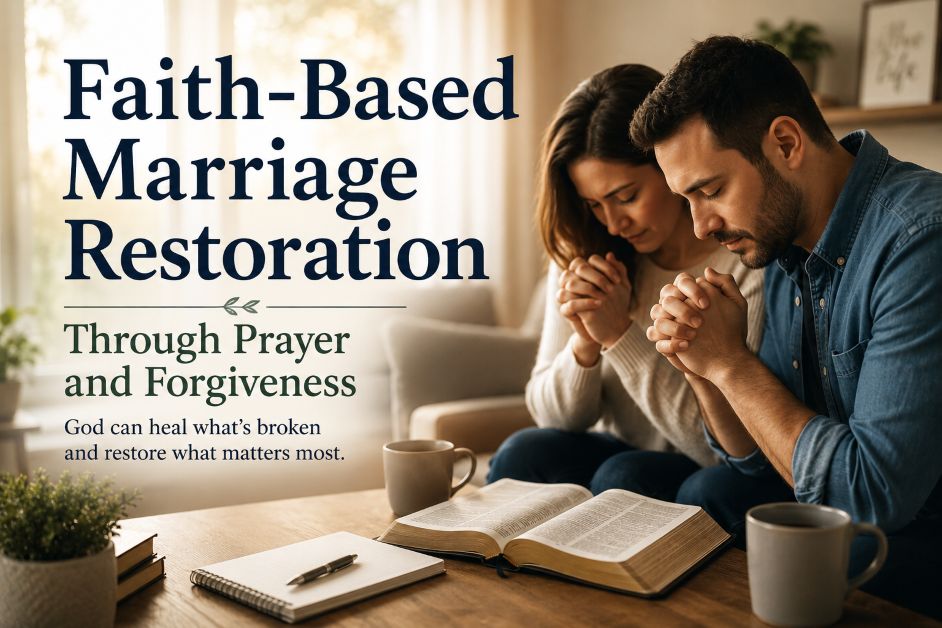
Marriage can move through seasons of closeness, conflict, disappointment, and deep hurt. When communication breaks down or trust is damaged, couples may wonder whether healing is still possible. Faith-Based Marriage Restoration Through Prayer and Forgiveness begins by bringing that pain honestly before God while recognizing that meaningful restoration also requires repentance, responsibility, healthy communication, and consistent change.
A faith-based marriage restoration process does not promise an instant solution. Instead, it creates space for biblical wisdom, prayer, forgiveness, and practical steps that can help couples respond to marital conflict with greater humility and grace. For Christians, the hope of Christian marriage restoration rests in God’s character, while each spouse remains responsible for his or her own choices.
What Does Faith-Based Marriage Restoration Mean?
Faith-Based Marriage Restoration Through Prayer and Forgiveness places the relationship within a Christ-centered marriage framework. Marriage is more than an emotional relationship; it is a covenant marriage that calls both spouses toward faithfulness, humility, compassion, and love.
A biblical marriage restoration process, therefore, addresses more than the visible conflict. It considers the attitudes, habits, wounds, and spiritual concerns contributing to the problem.
Marriage as a Biblical Covenant
A Christian understanding of marriage emphasizes commitment, sacrificial love, honesty, and mutual care. When difficulties arise, these principles can provide direction for responding to hurt.
This does not mean ignoring serious problems. Christian marriage support should encourage truth and wisdom alongside commitment.
Why Restoration Begins With God
A troubled marriage can create a strong desire to control circumstances or change the other person. Prayer redirects that focus toward God.
Instead of asking only, “How can I make my spouse change?” a spouse can also ask, “Lord, what do You want to change in me?”
That shift creates an important foundation for spiritual growth and marital healing.
Restoration Is a Process, Not an Instant Fix
Restoring a broken marriage may take time. Emotional wounds rarely disappear because a couple has one difficult conversation or says one prayer.
Healing may involve repeated conversations, sincere apologies, changed behavior, professional support, and continued prayer. God’s grace provides hope during the process without requiring couples to pretend that everything is already fixed.
Can Prayer Help Restore a Broken Marriage?
Prayer for marriage restoration can give couples a place to express grief, anger, confusion, hope, and dependence on God. Prayer can also help individuals develop patience and wisdom during difficult seasons.
Prayer should not become a tool for pressuring a spouse or avoiding necessary conversations. Instead, it can support a healthier prayer life while practical steps address the relationship itself.
Praying for Your Own Heart First
A powerful starting point is personal reflection.
A spouse might pray:
“God, show me where I need to grow. Help me respond with wisdom rather than anger. Give me the courage to acknowledge what I have done wrong.”
This approach encourages personal responsibility rather than placing every problem on the other spouse.
Praying for Wisdom, Patience, and Understanding
Marriage requires wisdom during moments of disagreement. Prayer can help a person pause before responding, listen carefully, and consider the consequences of harsh words.
Christian faith does not eliminate difficult emotions, but it can shape how those emotions are handled.
Praying Together When Both Spouses Are Willing
Shared prayer can encourage spiritual intimacy when both spouses feel comfortable participating. Even a brief prayer can create a moment of calm during a difficult conversation.
However, prayer should never be forced. Genuine spiritual connection develops through willingness, trust, and mutual respect.
What to Pray When Your Spouse Is Not Willing
Sometimes one spouse wants restoration while the other remains distant.
In that situation, focus on what you can control: your words, choices, boundaries, prayer, and willingness to seek wise support. You cannot control another person’s decisions.
This is where God’s faithfulness becomes an important source of hope.
How Forgiveness Supports Marriage Restoration
Forgiveness in marriage can be one of the most difficult parts of healing. Betrayal, harsh words, neglect, broken promises, or prolonged conflict can create deep resentment.
Biblical forgiveness does not require denying the pain.
What Biblical Forgiveness Means
Biblical forgiveness involves releasing personal vengeance and choosing a response shaped by God’s mercy and grace.
Forgiveness can be a process. A person may need time to process what happened before being emotionally ready to move forward.
Forgiveness Is Different From Forgetting
Emotional healing does not require pretending the hurt never happened.
Healthy forgiveness can acknowledge the truth while refusing to let resentment control every future interaction.
Forgiveness Is Different From Reconciliation
Forgiveness and reconciliation are related but different.
Forgiveness can begin with one person. Reconciliation requires meaningful participation from both people.
A marriage cannot rebuild genuine closeness without honesty, responsibility, and willingness to change.
Forgiveness Does Not Remove Healthy Boundaries
Healthy boundaries can exist alongside forgiveness.
A spouse can forgive while still requiring honesty, accountability, safety, or professional intervention. This distinction is especially important when there has been serious emotional or physical harm.
The Role of Repentance in Restoring a Marriage
Forgiveness becomes difficult to sustain when harmful behavior continues without accountability. Repentance, therefore, has an important role in marriage restoration.
Taking Responsibility for Personal Actions
Each spouse should examine personal choices rather than focusing exclusively on the other’s failures.
Taking responsibility can include acknowledging anger, dishonesty, criticism, neglect, defensiveness, or other behaviors that have contributed to marital problems.
What Genuine Repentance Looks Like
Genuine repentance involves more than saying, “I’m sorry.”
It can include:
- acknowledging the harm caused
- accepting responsibility
- making appropriate changes
- seeking accountability
- demonstrating consistency
- rebuilding credibility over time
These actions support genuine relational restoration.
Why Trust Requires More Than an Apology
Marital trust grows through repeated trustworthy actions.
A sincere apology can open the door to healing, but consistent behavior helps keep that door open.
Rebuilding Trust After Hurt and Betrayal
Healing from betrayal can require patience because betrayal can affect emotional security, communication, and confidence in the relationship.
Start With Honesty
Honest communication creates a foundation for rebuilding.
Avoiding difficult subjects may provide temporary relief, but it often leaves underlying issues unresolved.
Establish Consistent Actions
Consistency helps demonstrate that change is genuine.
Promises matter, but behavior provides evidence of whether those promises are being lived out.
Allow Time for Emotional Healing
One spouse may recover emotionally faster than the other. Pressuring someone to “move on” can create additional resentment.
Christian marriage healing allows room for grief while maintaining hope.
Create Healthy Boundaries
Boundaries clarify what behavior is acceptable and what steps may be necessary if harmful behavior continues.
Boundaries are not punishment. They can provide structure for healthier relationships.
Know When Professional Help Is Needed
Christian marriage counseling can provide structured support when couples cannot resolve recurring conflicts independently.
A qualified counselor can help couples address conflict resolution, communication, emotional wounds, betrayal, and trust.
Healing Communication Through Grace and Wisdom
Communication often becomes one of the first casualties of prolonged conflict. Couples may stop listening, become defensive, or repeat the same arguments.
Listen Before Defending Yourself
Listening does not mean agreeing with everything your spouse says. It means making an effort to understand the experience behind the words.
Speak Without Accusation
Statements focused on personal experiences can reduce unnecessary defensiveness.
Instead of saying, “You never care about me,” a person might say, “I felt alone when that happened.”
Learn to Apologize Sincerely
A meaningful apology identifies the behavior and recognizes its impact.
Replace Destructive Patterns With Healthy Habits
Repeated criticism, avoidance, defensiveness, and resentment can become familiar relational patterns.
Replacing those patterns requires intentional practice, patience, and biblical principles.
What If Only One Spouse Wants Restoration?
This is one of the hardest situations in marriage restoration through prayer.
What You Can Control
You can control:
- your behavior
- your communication
- your prayer life
- your boundaries
- your willingness to grow
- your response to conflict
What You Cannot Control
You cannot control:
- your spouse’s choices
- your spouse’s emotions
- your spouse’s willingness to change
- the timing of reconciliation
Recognizing this difference can reduce unhealthy attempts to control the outcome.
Trusting God With the Outcome
Christian hope does not mean assuming that everything will happen exactly as desired. It means continuing to trust God’s character while responding wisely to circumstances.
This can be part of surrendering control and learning to rely on God’s presence.
When Marriage Restoration Requires Professional or Pastoral Support
Some marital difficulties require additional support.
Christian Marriage Counseling
A qualified counselor can help couples identify recurring patterns and develop healthier communication and relationship skills.
Pastoral Guidance and Accountability
A mature pastor or trusted Christian leader can provide spiritual encouragement and accountability when appropriate.
When Safety Must Come First
Prayer and forgiveness should never be used to pressure someone to remain in an unsafe situation.
Physical violence, threats, coercive control, and severe abuse require appropriate safety planning and qualified professional support. Christian marriage support should uphold both truth and safety.
How Faith Changes the Restoration Journey
Faith during difficult seasons can reshape how couples understand pain and uncertainty.
From Control to Surrender
Instead of trying to control every outcome, individuals can bring their fears to God.
From Resentment to Forgiveness
Forgiveness can gradually loosen resentment while still allowing space for truth and accountability.
From Fear to Faith
Fear may remain part of the emotional experience for a time. Faith provides a way to move forward without requiring certainty about every outcome.
From Brokenness to Spiritual Growth
A difficult marriage season can expose areas where deeper spiritual growth is needed.
The goal is not to glorify suffering but to recognize that God can meet people within painful circumstances.
Spiritual Transformation Through Marriage Restoration
Marriage difficulties can also become an opportunity for deeper spiritual reflection.
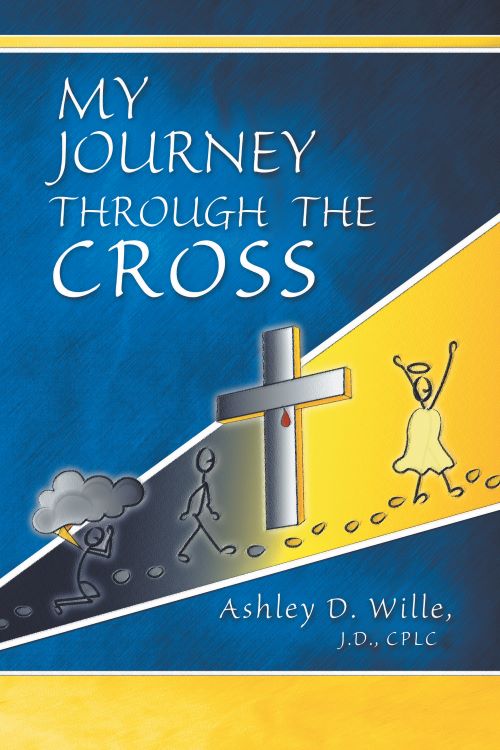
Journey through the cross spiritual transformation
The journey through the cross spiritual transformation theme reminds Christians that spiritual growth involves surrender, grace, sacrifice, and renewed identity in Christ.
Christian healing through suffering testimony
A Christian healing through suffering testimony can demonstrate how faith can remain meaningful during painful circumstances without suggesting that suffering itself is desirable.
Resting in grace beyond religious striving
Resting in grace beyond religious striving provides an important reminder that God’s grace is not earned through perfect performance.
Marriage restoration should not become another source of spiritual pressure.
Breaking spiritual strongholds through intimacy with God
Breaking spiritual strongholds through intimacy with God can involve prayer, Scripture, confession, wise community, and an increasing awareness of God’s presence.
Christian identity healing from emotional abandonment
Christian identity healing from emotional abandonment can help address feelings of rejection, insecurity, or unworthiness that sometimes affect relationships.
A person’s identity in Christ should not depend entirely on a spouse’s approval.
A Step-by-Step Faith-Based Marriage Restoration Plan
Step 1 — Pray Honestly
Bring the real emotions to God rather than hiding pain behind religious language.
Step 2 — Examine Your Own Heart
Identify personal attitudes and behaviors that need attention.
Step 3 — Practice Biblical Forgiveness
Choose forgiveness while allowing the healing process to develop honestly.
Step 4 — Address Harm and Take Responsibility
Name problems clearly and make meaningful changes.
Step 5 — Rebuild Communication
Practice listening, honesty, patience, and respectful conversation.
Step 6 — Establish Healthy Boundaries
Create appropriate boundaries around harmful or destructive behavior.
Step 7 — Rebuild Trust Through Consistency
Allow trustworthy actions to accumulate over time.
Step 8 — Seek Wise Christian Support
Consider pastoral counseling, Christian marriage counseling, or other qualified professional support when needed.
Step 9 — Develop New Marriage Habits
Create practical rhythms for communication, prayer, shared activities, and emotional connection.
Step 10 — Continue Growing Together in Faith
Long-term restoration requires continued attention. Spiritual intimacy, prayer, Scripture, and mutual growth can strengthen the foundation of the relationship.
Frequently Asked Questions About Faith-Based Marriage Restoration
Can God restore a broken marriage?
God can bring healing, wisdom, forgiveness, and transformation into painful marital situations. However, restoration also involves human choices, and one spouse cannot guarantee another person’s response.
Can prayer restore a marriage?
Prayer can support marital healing by bringing pain, decisions, and hopes before God. Prayer works alongside honest communication, repentance, accountability, counseling, and practical change.
Does forgiveness mean I have to trust my spouse immediately?
No. Forgiveness and trust are different. Forgiveness can be offered while trust is gradually rebuilt through consistent behavior.
What if my spouse refuses counseling?
You can still seek individual counseling, pastoral support, or other qualified guidance. Personal growth does not have to wait for another person’s participation.
How long does marriage restoration take?
There is no universal timeline. The process depends on the nature of the conflict, the willingness of both spouses, the depth of the wounds, and the consistency of meaningful change.
Can a marriage recover after betrayal?
Some marriages do recover after betrayal, but recovery requires honesty, repentance, accountability, patience, and rebuilding trust. Professional support may also be valuable.
Does God want me to stay in an abusive marriage?
Christian faith does not require a person to remain in danger. Abuse should be addressed seriously, with safety and qualified professional support taking priority.
Conclusion: Trusting God Through the Restoration Journey
Faith-Based Marriage Restoration Through Prayer and Forgiveness is a process of bringing a hurting relationship before God while also taking practical responsibility for healing.
Prayer can provide spiritual direction. Forgiveness can address resentment. Repentance can create meaningful change. Communication can rebuild a connection. Consistency can gradually restore marital trust.
Most importantly, restoration does not require pretending that pain does not exist. God’s grace, truth, wisdom, and compassion can meet people in difficult seasons.
A Christ-centered approach allows couples to pursue healing while recognizing that each person has choices and responsibilities. Through prayer, honest reflection, forgiveness, healthy boundaries, wise support, and continued Christian faith, couples can approach marriage difficulties with greater hope and wisdom.